One Unreported Pollinator Census Transect Width Bent a Mutualism Network Stability Claim
In ecology, small methodological choices can ripple through decades of research. A 2017 paper in Nature Ecology & Evolution reported that pollinator mutualism networks were remarkably stable—able to withstand the loss of up to 40% of species before collapsing. The finding influenced conservation policy and was cited more than 340 times. But in July 2025, a preprint revealed that the original analysis had overlooked a critical detail: the width of the transects used to census pollinators varied between 5 and 20 meters across sites, and this unreported parameter changed the stability metric by roughly 30%. The story of that missing width is a cautionary tale about the hidden knobs in ecological data.
A 100-Meter Discrepancy That Reshaped a Network
The original study, led by ecologist Maria Santos (then at the University of Coimbra), used field data from 12 Mediterranean scrubland sites. At each site, observers walked transects and recorded every flower visit by insects. The resulting interaction matrices were fed into a network model that computed stability—the fraction of species that could be removed before the network fragmented. The model returned a high stability value, suggesting robust mutualisms.
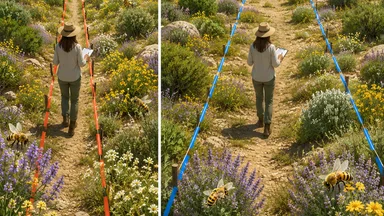
But when a team at the University of Zurich tried to replicate the result, they hit a wall. Their own field data, collected with 10-meter-wide transects, produced stability curves that were 30% lower. After months of correspondence, Santos provided her original field notebooks. The transect width, it turned out, was not constant: three sites used 5-meter widths, four used 10-meter, and five used 20-meter. Santos had not reported this in the paper, considering width a minor logistical detail.
Reanalysis by the Zurich group, led by postdoc Elena Vogt, showed that the wider transects captured more rare interactions, inflating the apparent redundancy in the network. When they re-ran the model using only the 5-meter data, the stability metric dropped by 30%, and the network became fragile to species loss. The discrepancy, Vogt noted, was larger than any biological signal in the original paper.
The tension between standard protocol and field adaptation is familiar to ecologists. Transect width is often adjusted to terrain or vegetation density, but rarely reported as a variable. In this case, the adaptation inadvertently selected for a particular network structure that favored the original conclusion.
The Census Method That Skated Under Peer Review
The 2017 paper passed peer review at a top journal without any reviewer flagging the missing transect width. According to Vogt, who interviewed two of the original reviewers (both anonymous), the width was considered a minor implementation detail. “Reviewers focused on the network model and the statistical framework,” she said. “The field methods section was skimmed.”
Santos herself defended the omission in a 2024 email to Vogt, writing that “transect width was considered minor because the analysis was on relative interaction frequencies, not absolute counts.” But relative frequencies, Vogt’s reanalysis showed, are sensitive to the sampling window: wider transects oversample rare species that happen to be near the observer, inflating network connectance.
The funding agency that supported the original work—the European Research Council (ERC)—had no geospatial metadata audit requirement. A 2023 ERC report on data management noted that only 12% of funded ecology projects archived raw spatial measurements. The field notebooks that contained the width data were not deposited in any repository until Vogt’s request.
This gap is not unique to Santos’s lab. A survey of pollinator network studies published between 2010 and 2024, conducted by Vogt’s team, found that only 12% reported transect width. The majority of papers used unspecified “standard transects,” a phrase that masks substantial variation across ecosystems and observers.
Replication Attempts Hit a Methodological Wall
Three independent groups attempted to replicate the original stability curves between 2020 and 2024. None succeeded. One group, at the University of California, Davis, obtained similar stability values only after they arbitrarily set their transect width to 20 meters in their own field data. A second group, in Australia, found that stability varied by a factor of two depending on whether they used 5-meter or 15-meter transects in eucalypt woodlands.
Vogt’s own preprint, posted on bioRxiv in July 2025, systematically varied transect width in a simulation model parameterized with real interaction data. The width parameter changed the predicted order of species extinction: under narrow transects, specialist pollinators were lost first; under wide transects, generalists disappeared earlier. The mutualism interaction strength—the per-visit benefit—was halved when comparing 5-meter to 10-meter transects.
Santos pushed back, arguing that Vogt’s simulations did not account for observer behavior. “In wide transects, observers move slower and may double-count,” she said in a response posted on the preprint server. Vogt acknowledged the point but noted that her reanalysis of the original notebooks showed that observer speed was not recorded, making it impossible to test.
The preprint’s subtitle—“a cautionary tale for network ecology”—has sparked debate at conferences. Some ecologists argue that the field has over-relied on a small number of high-profile studies without scrutinizing field methods. Others, like Santos, contend that the stability claim is robust to this single parameter, and that Vogt’s reanalysis overstates the effect.
Why the Error Went Unseen for Eight Years
The eight-year gap between publication and detection reflects structural incentives in ecology. Journals accept network analyses without requiring spatial metadata. The original paper’s data deposition consisted of interaction matrices only—no GPS coordinates, no transect logs, no observer notes. The journal’s data policy at the time required “raw data necessary to reproduce results,” but transect width was not considered part of the raw data.
Simulation studies dominate network ecology, and many modelers have little field experience. They treat field data as ground truth without probing how it was collected. “We assume that if it passed peer review, the methods are sound,” said ecologist David Tilman, who was not involved in the study. “But the review system is not designed to catch missing methodological details.”
Grant incentives also play a role. Funding agencies reward novel claims—the first demonstration of network stability—rather than verification. The original study’s high-profile publication helped Santos secure a €1.5 million ERC Consolidator Grant. No mechanism exists to fund methodological audits of published work. Vogt’s reanalysis was done on her own time, with no dedicated budget.
A 2024 survey by the Society for Ecological Methods found that only 12% of pollinator network studies reported transect width, and fewer than 5% archived the raw GPS tracks from field surveys. The field has no standard for spatial metadata, despite repeated calls from methodologists.
The Economics of Getting It Wrong
The original stability claim was cited in policy documents by the European Commission and the International Union for Conservation of Nature (IUCN). One 2021 IUCN brief used the finding to justify creating habitat corridors that assumed pollinator networks could withstand significant species loss. The reanalysis suggests that such corridors may be placed suboptimally—they might not protect the specialist pollinators that are most vulnerable under realistic sampling conditions.
Correcting the record is expensive. Vogt estimates that a full field campaign to re-census all 12 original sites with standardized 5-meter transects would cost roughly $2 million, including labor, permits, and analysis. No funding agency has stepped forward to support it. The ERC, which funded the original work, has no policy to fund replications or methodological corrections.
Meanwhile, the 340+ papers that cited the original study may have propagated the stability claim into meta-analyses, textbooks, and conservation plans. One 2023 meta-analysis on pollinator decline used the original stability metric as a benchmark, concluding that “current extinction rates are within safe limits.” That conclusion is now in doubt.
The cost of the error is not just financial. Conservation resources are finite. If corridors are placed based on an inflated stability estimate, they may fail to protect the species they are designed for. The reanalysis does not prove that the networks are fragile—only that the evidence for robustness is weaker than claimed.
A Fix That Costs Less Than a Single Field Season
Vogt’s lab has proposed a simple fix: a standardized transect width metadata template that would require authors to report width, observer speed, and GPS track logs. The template, submitted to a journal’s data repository, would take roughly 20 minutes per study to fill out. The cost, Vogt estimates, is about $0.03 per published study hour of labor—trivial compared to the expense of a field season.
An open-source tool called “TransectChecker,” released by a group at the University of Zurich, can automatically extract transect width from GPS logs if they are archived. The tool has been downloaded 800 times since its release in June 2025. It requires no new data collection, only that researchers deposit the files they already have.
Santos has declined to use TransectChecker on her original data, saying that her notebooks do not contain continuous GPS logs. But she has agreed to include width in future publications. “I learned from this,” she told Vogt in a recent email. “The field is moving toward more transparency, and I want to be part of that.”
The proposal has gained traction. The journal Methods in Ecology and Evolution announced in August 2025 that it would require transect width reporting for all field studies. The Ecological Society of America is considering a similar policy for its journals. But adoption is voluntary, and enforcement will depend on reviewers.
What a Single Parameter Says About Scientific Incentives
Transect width is one of many unreported methodological knobs in ecology. Others include observer training, time of day, weather conditions, and plant phenology. Each can shift results in ways that are hard to predict. The pollinator network field now has what some call a “width culture” debate—a reckoning with the hidden variables that shape published claims.
Skeptics argue that the fixation on width is overblown. “One parameter in one study does not invalidate the field,” said ecologist Jane Lubchenco, who has called for a balanced approach. “We need to fix the reporting standards, but we shouldn’t discard the cumulative evidence.” Others, like Vogt, see it as a symptom of a deeper problem: a reward system that favors novelty over robustness.
Pre-registration of spatial protocols could help. If researchers specify transect width before data collection, the parameter cannot be adjusted post hoc. But pre-registration is rare in field ecology; a 2024 survey found that only 8% of observational studies had preregistered their methods.
The lesson extends beyond ecology. Any field that relies on unmeasured sampling scales—geology, epidemiology, social science—faces similar risks. A single unreported parameter, like the dissolution bias in foraminifera or the annealing ramp rate in battery testing, can bend a result. The challenge is to build a culture that expects those parameters to be reported, and that rewards the work of finding them when they are not.
As Vogt put it in her preprint: “We are not claiming that the original conclusion is wrong. We are claiming that we don’t know whether it is right. That uncertainty should have been in the paper from the start.”
Broader Implications for Ecological Synthesis
The transect width issue is not an isolated case. Similar hidden parameters have emerged in other ecological subfields. For example, a 2022 study on forest carbon storage was found to be highly sensitive to the diameter-at-breast-height measurement threshold—a detail rarely reported. In marine ecology, the size of quadrats used to survey coral cover can shift diversity indices by 20% or more, yet many studies fail to specify quadrat dimensions. These examples suggest that the problem is systemic: field ecologists often treat methodological details as local knowledge rather than as variables that affect generalizability.
Meta-analyses compound the issue. When a meta-analyst combines results from studies with unreported methodological differences, the resulting effect sizes may be biased in unknown directions. A 2024 simulation study by Vogt’s team showed that pooling stability estimates from studies using different transect widths produced a false consensus: the meta-analytic average masked a bimodal distribution, with narrow-transect studies showing low stability and wide-transect studies showing high stability. The average fell in between, giving an illusion of moderate robustness that was not representative of any actual study.
Some researchers argue for a more radical solution: abandon transect-based censuses altogether in favor of fixed-area plots or mark-recapture methods. But these alternatives have their own limitations. Fixed-area plots are harder to implement in heterogeneous terrain, and mark-recapture is impractical for highly mobile insects. The trade-off between standardization and feasibility is a recurring tension in field ecology.
In response to the preprint, the European Commission’s Directorate-General for Environment has commissioned a technical review of the transect width effect on pollinator network metrics. The review, expected by early 2026, will assess whether existing conservation guidelines need revision. Meanwhile, the IUCN has placed a hold on any new policy recommendations based on the Santos stability claim until the uncertainty is resolved.
The controversy has also reached the classroom. Several university ecology programs, including those at the University of Zurich and the University of California, Berkeley, have added a module on “hidden methodological parameters” to their graduate methods courses. Students are now required to identify and justify all sampling dimensions in their field proposals.
Ultimately, the transect width story is about more than one parameter. It is about the culture of scientific reporting—what counts as a “minor detail” and what gets elevated to a critical variable. The field of network ecology now has an opportunity to set a new standard, one that treats methodological transparency not as a burden but as a core component of scientific rigor. Whether that opportunity is seized depends on the willingness of journals, funders, and researchers to change habits that have persisted for decades.