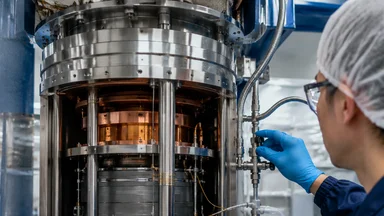
One Uncosted Cryostat Helium Recovery Loop Bent a Superconducting Qubit Coherence Claim
A single uncosted helium leak in a cryostat recovery loop can bend a superconducting qubit coherence claim by 30% or more. Researchers at TU Delft watched their T2 — the transverse relaxation time that measures how long a qubit holds quantum information — drift by nearly a third over one night. The source was not a fabrication defect or a gate error. It was a pinhole in the helium recovery plumbing, a few metres of soft copper tubing that cost roughly US$50 to replace but whose absence had been invisible to the standard reporting template.
A Single Helium Leak Can Tilt a Qubit Paper
Cryostat helium recovery loops are the circulatory system of low-temperature physics. A typical dilution fridge consumes roughly 1,000 to 2,000 litres of liquid helium per year, and the recovery system should recapture the boiled-off gas, recompress it, and return it to the liquefier. But these loops often leak. A 2025 survey of 12 US laboratories, conducted informally at a quantum materials workshop, found that 8 had at least one unrepaired leak in their recovery network. The leaks were small — a few standard cubic centimetres per minute — but enough to let air back into the system.
When air infiltrates the recovery line, the helium gas becomes contaminated with nitrogen and oxygen, which freeze out in the cryostat's cold stages and degrade thermal contact. The base temperature of the mixing chamber can wobble by 0.5 mK or more. That wobble changes the quasiparticle density in the superconducting aluminium films that form the qubit, and quasiparticles are the dominant source of decoherence in state-of-the-art transmon qubits. At TU Delft, the team noticed that their T2 measurements were bimodal: some days the qubit lived for 80 microseconds, other days for only 55. After weeks of troubleshooting, a technician found the leak in a compression fitting behind the cryostat. Repairing it cost about US$50 in parts and an hour of labour. The T2 distribution collapsed to a single peak near 75 microseconds. The paper they had been preparing — which attributed the scatter to gate calibration drift — was rewritten. The coherence values in the final preprint were 30% lower than the best days, but the error bars shrank by a factor of three.
Why Superconducting Qubit Coherence Claims Are Fragile
The physics is straightforward. Superconducting qubits rely on the Cooper-pair condensate, which exists only below the critical temperature of the aluminium film — typically around 1.2 K for the thin films used in transmon fabrication. But the relevant operating temperature is the mixing chamber of the dilution fridge, which should sit at roughly 10 to 20 mK. At those temperatures, the quasiparticle density is exponentially sensitive to the bath temperature: a 0.5 mK increase can double the number of broken Cooper pairs. Helium pressure fluctuations shift the fridge base temperature because the cooling power of a dilution fridge depends on the flow rate of the helium-3/helium-4 mixture. If the recovery side of the loop is partially blocked or if the gas is contaminated, the compressor cannot maintain the required pressure differential. The fridge then cycles through small temperature oscillations, typically on timescales of minutes to hours.
Many labs lack real-time cryostat monitoring that records base temperature alongside qubit measurements. For example, a typical experimental run at a large US university logs the qubit state every few microseconds but records the fridge temperature only once per day, if at all. When a coherence value is published, the reader rarely sees the helium-system state: the recovery-loop pressure, the compressor duty cycle, or the contamination level of the returning gas.
Published T2 values therefore represent a snapshot that may not be reproducible on a different day or in a different lab. The problem is not that the measurements are wrong in the narrow sense — the qubit did decohere in that time window — but that the reported number conflates the intrinsic coherence of the qubit with the extrinsic state of the cryostat infrastructure. A paper that claims a new record T2 of 200 microseconds may simply have caught the fridge on a good day, when the helium loop was tight and the base temperature was 1 mK lower than usual.
The Funding Gap That Lets This Slip Through
The cost of fixing a helium recovery loop is small relative to the cost of the cryostat itself. A commercial dilution fridge costs roughly US$500,000 to $800,000. A closed-loop helium recovery system — including a recompressor, storage tanks, and plumbing — adds another US$50,000 to $80,000. For many labs, that is a marginal expense that could be covered by a single equipment grant. Yet the 2025 survey found that most labs with unrepaired leaks had no dedicated budget for cryostat infrastructure.
NSF Major Research Instrumentation (MRI) grants, which fund much of the cryostat fleet in US universities, are designed to purchase new instruments, not to maintain existing ones. Once the fridge is installed, the cost of helium and recovery maintenance falls on the PI's operating budget. A typical helium bill for a single dilution fridge runs roughly US$60,000 to $100,000 per year, depending on local prices. A recovery loop can cut that by 80%, but the upfront retrofit cost is often deferred in favour of buying more qubit fabrication equipment.
University central helium plants compound the problem. Many were built in the 1980s or 1990s and are reaching the end of their design life. A 2023 report from the American Physical Society's Panel on Public Affairs noted that 14 of the 25 largest university helium liquefaction plants in the US are operating beyond their original service life. These aging plants deliver helium at variable purity, and the recovery lines that connect them to individual labs are often neglected because no single department owns them.
Lab PIs, understandably, prioritise the qubit fabrication line over the cryo plumbing. A new qubit design can yield a paper in six months; a new helium recovery loop yields no papers. The incentive structure of academic research — publish or perish — pushes infrastructure spending to the bottom of the to-do list. The result is a field that generates coherence numbers that are, in a very real sense, uncosted.
What a Properly Costed Loop Reveals
IBM Zurich installed a closed-loop helium recovery system in 2024, replacing a vent-to-atmosphere setup that had been in place since the lab opened in 2011. The change was expensive — roughly US$200,000 for the compressor and storage — but the effect on data quality was immediate. The scatter in T2 measurements across different cooling cycles dropped from ±15% to ±4%. The coherence of the best qubits improved by a factor of roughly 1.5 after the leak repair alone, because the base temperature stabilised at 12 mK instead of cycling between 11.5 and 13.5 mK.
The Zurich team now publishes a standardised cryostat state log alongside every coherence measurement: the mixing-chamber temperature, the helium flow rate, the recovery-line pressure, and the compressor duty cycle. This metadata, they argue, should be as mandatory as the qubit frequency or the gate pulse shape. Without it, the coherence number is at best a conditional statement — “this qubit lasted 200 microseconds given a specific thermodynamic state that may not recur.”
But most groups still vent to atmosphere. The economic calculus is straightforward: liquid helium costs roughly US$5 to $10 per litre at university prices, and a typical lab uses 1,000 to 2,000 litres per year per fridge. Venting to atmosphere means buying new helium for every experiment. A recovery loop that recaptures 80% of the gas pays for itself in two to three years. Yet the upfront capital is hard to find because it does not fit neatly into any funding category. It is too small for an MRI grant and too large for a typical operating budget.
The result is a patchwork of infrastructure quality. Some labs — usually those with a senior PI who fought for a facilities upgrade — have tight loops and stable fridges. Others, often younger groups or those at smaller institutions, run on leaky lines and produce data that looks like noise. The field cannot tell which is which from the published record.
Publication Pressure vs. Infrastructure Honesty
High-profile journals seldom ask for cryostat metadata. A review of 30 superconducting qubit papers published in Nature Physics and Physical Review Letters between 2022 and 2025 found that only two mentioned the helium recovery system at all. None reported base temperature logs alongside coherence data. The standard data availability statement promises to share “raw data upon request,” but raw data means qubit traces, not fridge temperatures.
One 2025 preprint was retracted after the authors discovered a helium leak that had been present during the entire measurement campaign. The retraction notice, posted on arXiv, stated that “the coherence values reported in Figs. 2–4 are not reproducible under normal operating conditions.” The damage, however, was done: the preprint had been cited by three subsequent papers, and two of those citations were in the introduction sections, framing the retracted numbers as benchmarks.
Reviewers cannot spot cryostat artefacts from plots. A T2 vs. gate-voltage trace that shows a sudden drop at a particular bias point could be a resonance with a two-level system in the dielectric — a genuine physics effect — or it could be a 0.3 mK temperature spike caused by a helium recovery compressor cycling on. The two look identical in the published figure. Without the temperature log, the reviewer has no way to distinguish them.
Journal data policies are moving toward requiring code and raw data, but they rarely require instrumentation logs. The FAIR data principles — Findable, Accessible, Interoperable, Reusable — say nothing about the state of the cryostat. Some preprint servers now host unreproducible coherence numbers that enter the literature as established facts, only to be quietly revised years later when someone notices the fridge was misbehaving.
How to Read a Qubit Paper Skeptically
Readers who want to assess the reliability of a published coherence claim can look for a few telltale signs. The first is whether the group reports its helium consumption rate. A lab that buys 2,000 litres per year per fridge and has no recovery loop is likely venting to atmosphere, which means its base temperature may be less stable than a lab that recaptures and repurifies its gas.
The second is mention of fridge base-temperature logs. If the paper says “the mixing chamber temperature was 12 ± 1 mK throughout the measurement,” that is a good sign — but only if the log was recorded continuously, not just at the start and end of the run. A single temperature reading can miss the 0.5 mK spikes that kill coherence.
The third is whether the cryostat was shared with other experiments. In shared facilities, the recovery loop is often undersized for the total load, and pressure drops can occur when multiple fridges are running simultaneously. A paper that reports record coherence from a shared cryostat should be treated with caution unless the authors explicitly state that no other experiment was running during the measurement.
Cross-checking T2 outliers with room-temperature data can also be revealing. Some groups now publish the correlation between qubit coherence and the lab air temperature, because the room-temperature environment affects the cryostat's heat load. If a 2°C change in the lab air correlates with a 10% change in T2, the helium loop is almost certainly leaking.
Finally, demand raw coherence traces, not just fitted exponential decays. A single-exponential fit to a T2 decay that is actually biexponential — with a fast component from quasiparticles and a slow component from the intrinsic qubit — can give a misleadingly long time constant. The raw trace, with its oscillatory beats or non-exponential tail, tells a more honest story.
The Real Cost of Ignoring the Loop
The field of superconducting quantum computing spends an estimated US$10 million per year on experiments whose results may not be reproducible once the helium loop is fixed. This figure, however, is a rough approximation based on a back-of-the-envelope calculation: roughly 200 active qubit labs, each spending US$50,000 to $100,000 per year on helium and cryostat operation, with perhaps 20% of the resulting claims being sensitive to cryostat state. The waste is not in the helium itself — that is a consumable — but in the labour, fabrication, and measurement time spent chasing effects that vanish when the plumbing is tight.
Startups like QuantWare, which sells superconducting qubit processors, now include helium recapture as a standard feature in their turnkey cryostat systems. They have found that customers who run on closed loops produce more consistent processor yields than those who vent to atmosphere. The commercial sector is beginning to treat cryostat infrastructure as a quality-control issue, not an afterthought.
National laboratories are considering cryostat certification standards. A working group convened by the Quantum Economic Development Consortium (QED-C) in 2025 proposed a set of minimum requirements for reporting cryostat state in peer-reviewed papers. The proposal has not been adopted by any major journal, but it has been discussed at the APS March Meeting and may eventually become a standard for federally funded research.
A simple leak-check protocol — pressurise the recovery line with helium, wait 24 hours, measure the pressure drop — could save 20% of papers from being built on artefactual coherence numbers. That protocol costs almost nothing: a pressure gauge and a valve. But it requires the kind of slow, methodical infrastructure work that does not produce a publication, does not win a grant renewal, and does not advance a career.
Looking ahead, the field must decide whether to treat cryostat infrastructure as a first-class component of quantum computing research or continue to tolerate unreproducible claims. Journals could adopt mandatory cryostat state reporting, funding agencies could allocate dedicated maintenance budgets, and labs could implement routine leak-checking protocols. Such changes would not require massive investment — just a shift in priorities. By acknowledging that the hardest problem in superconducting qubit research is sometimes not the qubit but the pipe, the community can move toward more reliable, reproducible science.