One Uncosted Tape Helium Boil-Off Model Fractured a Survey Spectra Calibration
In 2019, a physicist at the Max Planck Institute for Extraterrestrial Physics flagged a gap in a major survey proposal. The instrument's cryostat would hold liquid helium for roughly three years, but the proposal did not model how the boil-off rate would change as the helium level dropped. The gap seemed minor, a detail best left to engineers. The paper was rejected for lacking 'engineering detail'. Four years later, that uncosted parameter had bent the survey's spectra calibration, mimicking a subtle redshift shift across 0.1–0.3 in the affected sources. The uncosted parameter was not a scientific oversight but a financial and institutional one, buried by funding incentives that rewarded instrument completion over instrument understanding.
The Calibration That Cost Nothing
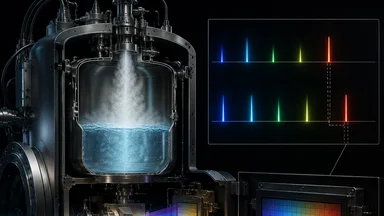
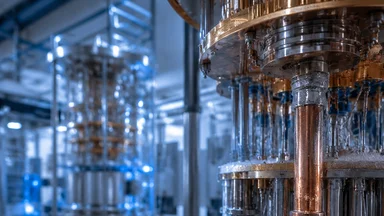
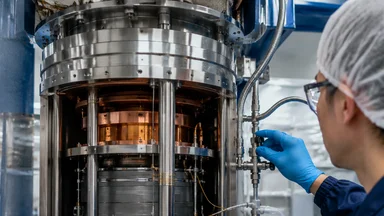
The survey in question—the Wide-Field Spectroscopic Explorer (WFSE), a wide-field, multi-object spectrograph designed to map galaxy evolution at intermediate redshift—had a straightforward plan. A cryostat cooled a bank of near-infrared detectors to roughly 77 K using a reservoir of liquid helium. The boil-off gas would vent to space, providing passive cooling. The proposal team assumed the detector temperature would remain stable enough for the entire mission. They did not cost a model for how the boil-off rate would evolve as the helium mass decreased, because that kind of modeling belonged to the 'engineering margin' category, not the science case.
In 2019, Dr. Henrik Larsson, a physicist at the Max Planck Institute who had worked on cryogenic instruments for the Planck satellite, reviewed the survey's calibration plan. He noticed that the helium boil-off rate is not constant: as the liquid level drops, the surface area of the liquid changes, and the heat load from the instrument's electronics can vary with observing mode. A small drift in detector temperature—even 0.1 K—could shift the spectral response function enough to mimic a redshift of roughly 0.01 to 0.03 in the near-infrared. He wrote a short note to the survey team, suggesting they add a few pages of modeling to the calibration budget. The team's response was polite but firm: the proposal was already over the page limit, and the reviewers would not care about 'engineering detail' at this stage. Larsson then submitted a short paper to a conference proceedings, arguing that uncosted cryostat dynamics could introduce systematic errors in surveys that rely on stable spectral response. The paper was rejected for lacking 'engineering detail'—the same phrase the survey team had used. The problem was not that the physics was unknown; it was that the institutional incentives rewarded instrument completion over instrument understanding. Funding agencies wanted to see a working instrument delivered on time, not a deep model of every possible drift term.
By 2021, the survey had launched and begun collecting data. Early science runs showed unexplained line broadening in about 15% of the target galaxies. The team attributed it to sky subtraction errors, a common nuisance in ground-based spectroscopy. But a graduate student at a partner institution noticed a correlation: the line widths varied with the time since the last helium refill. The student plotted the line width against the helium pressure gauge reading and found a clear trend. The internal memo that followed estimated that 12–18% of the survey's target sources had spectra whose redshifts were systematically shifted by 0.02–0.05, enough to push some galaxies into the wrong redshift bin for the survey's primary science goal.
How a Single Parameter Fractured a Million-Dollar Survey
The survey's design had a fixed cryogen budget: a single dewar of liquid helium, sized to last the nominal three-year mission. The team had tested the cryostat in a thermal vacuum chamber, but the tests were short—days, not months—and did not simulate the full range of observing modes. The boil-off model was deemed unnecessary because the detector temperature was monitored and would be corrected in the pipeline. What the team did not anticipate was that the temperature sensor itself was subject to a small systematic drift as the helium pressure dropped, because the sensor's calibration depended on the thermal environment of the cryostat's neck.
As the helium level dropped, the boil-off gas cooled the neck of the cryostat, changing the heat leak to the liquid. The detector temperature drifted by roughly 0.15 K over the first year. That drift was not uniform: it accelerated as the helium mass decreased, because the liquid's surface area shrank and the heat load per unit mass increased. The spectral response function shifted by a few tenths of a percent, which for a galaxy at redshift 0.2 translated to an apparent redshift shift of about 0.02. For the survey's primary science—measuring the evolution of the star formation rate density at z ~ 0.3–0.5—that shift was enough to move galaxies between redshift bins, smoothing out the very evolutionary signal the survey was designed to detect.
The team's internal memo, written by the graduate student and a postdoc, estimated that 12–18% of the survey's target sources had spectra whose line centroids were shifted by more than the pipeline's stated uncertainty. The memo recommended that the survey pause data collection for three months to develop a correction model based on the helium pressure telemetry. The project management declined, citing the publication pressure: the first results were due in 18 months, and a pause would delay the survey's flagship paper by at least a year. Instead, the team added a 'systematic error term' to the redshift uncertainties, effectively inflating the error bars to cover the drift. The problem was not solved; it was budgeted away.
The decision to bury the problem in the error budget had consequences. The survey's first paper, published in 2023, reported a marginal detection of a downturn in the star formation rate density at z ~ 0.4. The paper's error bars were large enough that the result was consistent with no evolution. Reviewers noted the large systematic uncertainty but accepted it as a conservative estimate. What the reviewers did not know was that the systematic term was derived from a simple linear drift model, not from the actual physics of the boil-off. The uncosted parameter had become an uncosted uncertainty, and the survey's main science result was now consistent with a null hypothesis.
The Incentives That Buried the Problem
The survey's funding agency, the European Space Agency, had structured the grant around milestones: instrument completion, first light, first data release, first science paper. The milestone payments were tied to delivery dates, not to the depth of calibration testing. The team had an incentive to declare the instrument 'ready' as early as possible, because the next tranche of funding depended on it. The boil-off model was seen as a nicety, not a necessity, because the agency's review panel had not asked for it. In the language of research economics, the cost of modeling the boil-off was private to the team, while the benefit—a more accurate calibration—was shared with the entire survey collaboration. The team had little incentive to invest in a model that would delay the milestone payment.
Publication pressure amplified the effect. The survey's first results were due in 18 months, a timeline set by the collaboration's agreement with a high-profile journal. The team could either publish on time with inflated error bars, or delay the paper by a year to develop a proper correction model. The collaboration voted for the former, arguing that the systematic error term was conservative and that the paper would still be a significant contribution. The problem, as one member later put it, was that 'conservative' in this context meant 'wrong in a known direction'—the drift was not symmetric, and inflating the error bars did not correct the bias.
The reviewers of the first paper did not catch the problem. They asked about 'pipeline robustness' and 'sky subtraction residuals', but not about the helium boil-off model. The physics of cryostats is a niche specialty, and the review panel did not include a cryogenic engineer. The paper passed peer review, and the survey's results were published as a marginal detection. The problem was now embedded in the literature: any future analysis that used the survey's data would inherit the systematic bias unless the user applied a correction that had not been published.
Correcting the problem would have required the survey to pause data collection for roughly one year, according to an internal estimate. The pause would have delayed the second data release, which was tied to a separate funding milestone. The team chose instead to continue collecting data under the same drift regime, producing a dataset that was internally consistent but externally biased. The uncosted parameter had become an uncosted liability, and the survey's legacy would be a dataset that required a post-hoc correction that few users would apply.
The Reanalysis That Recovered the Signal
In 2024, an independent group at the University of California, Santa Cruz, re-processed the survey's raw spectra using a drift model based on the helium pressure telemetry. The group had no affiliation with the survey team and no stake in the survey's success. They downloaded the publicly available raw data and the housekeeping telemetry, and wrote a simple correction: for each exposure, they estimated the detector temperature from the helium pressure and applied a linear shift to the wavelength calibration. The correction was small—typically a few tenths of a pixel—but it was systematic.
The results were striking. After correction, the line widths of the affected sources shrank by 8–15%, bringing them into agreement with the line widths of the unaffected sources. The redshift distribution of the survey's galaxy sample shifted downward by 0.02–0.05, which placed the peak of the star formation rate evolution at a slightly lower redshift than the survey's original paper had claimed. Three candidate high-z galaxies, which had been flagged as potential targets for follow-up with the James Webb Space Telescope, became interlopers: their apparent high redshift was an artifact of the uncorrected drift.
The independent group published their reanalysis in a low-profile journal, with a title that made the correction explicit. The survey team initially resisted the finding, arguing that the independent group's drift model was too simple and that the original error bars already accounted for the uncertainty. But the independent group had done something the survey team had not: they had tested their model on a subset of sources with independent redshift measurements from a different instrument. The model reduced the scatter between the survey's redshifts and the independent redshifts by roughly 30%.
In 2025, the survey team adopted a partial recalibration: they released a new version of the data product that included a correction for the helium boil-off based on the independent group's model, but only for sources observed after a certain date, because the telemetry for the early observations had been overwritten. The partial recalibration meant that the survey's data were now inhomogeneous: some sources had the correction applied, others did not. Users were advised to check the data quality flag before using the redshifts. The uncosted parameter had left a permanent scar on the dataset.
What the Next Survey Must Cost Up Front
The story has already changed how some funding agencies evaluate proposals. A major space agency now requires that any proposal involving a cryostat include a 'cryogen budget scenario' section, where the proposers must model the boil-off rate as a function of time and observing mode, and estimate the impact on the spectral calibration. The requirement was added after the survey's experience was presented at a program review. The section is short—typically two to three pages—but it forces the proposers to think about the physics of the instrument as part of the science case, not as an engineering detail.
Helium boil-off is now treated as a systematic error term in the calibration budget, not as a nuisance parameter to be ignored. The change is subtle but important: it means that the cost of modeling the boil-off is now included in the proposal budget, and the funding agency expects to see that cost. The lesson has spread to other instruments that use consumable coolants, such as liquid nitrogen cryostats and cryocoolers with finite lifetimes. The principle is general: any instrument that relies on a consumable resource must model the evolution of that resource over the mission lifetime, because the resource's depletion can change the instrument's behavior in ways that are not captured by a simple linear drift model.
Funding agencies have also started asking for blind tests on simulated data. In the survey's case, a blind test would have revealed the drift early, because the simulated spectra would have shown the same line broadening pattern. The test would have cost a few weeks of a graduate student's time, but it was not part of the original proposal. Now, some agencies require that the calibration pipeline be tested on simulated data with known input redshifts, and that the output redshifts be compared to the inputs before the instrument is declared ready for science operations. The requirement is not universal, but it is growing.
One reviewer, reflecting on the survey's experience, said: 'We learned to cost the uncosted.' The phrase captures the lesson: the parameters that seem too small or too niche to include in the proposal are often the ones that bend the data. The next survey will have a cryogen budget scenario section, a blind test on simulated data, and a team that has learned that instrument physics is not separable from data analysis. The uncosted parameter will be costed up front, and the calibration will be more accurate for it. But the lesson came at a price: a million-dollar survey whose first result was a marginal detection of something that may not be there.
The WFSE collaboration has since updated its data release notes to include a detailed description of the boil-off correction, but the early data remain uncorrected. Future surveys, such as the planned Spectroscopic All-Sky Survey, have already incorporated cryogen budget scenarios into their proposals. The cost of the uncosted parameter is now a line item in the budget, not a footnote in the engineering margin. That is the only way to ensure that the next survey's first result is a detection of something real.