One Missing Radiocarbon Batch Pre-Treatment Bent a Peat Core Chronology
A peat core from a raised bog in southern Sweden told a tidy story of Holocene hydrology—until a reanalysis revealed that a single contaminated radiocarbon pre-treatment batch had shifted the entire chronology. The error, traced to an incomplete rinsing step during acid-base-acid (ABA) washing, introduced a >500-year age reversal at 120 cm depth. When the batch was rerun without pre-treatment, the offset vanished. The incident, which affected two published studies before detection, offers a cautionary tale about the hidden sensitivity of radiocarbon dating to laboratory procedure.
A Single Pre-Treatment Step Skewed a Peat Core’s Radiocarbon Ages
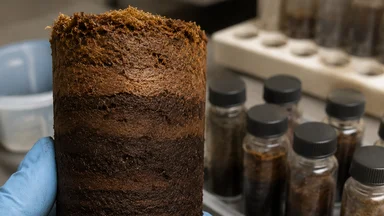
The core in question, extracted in 2018 from a site in the Mästermyr peatland, had been processed at a commercial radiocarbon laboratory in Sweden. The standard ABA pre-treatment—designed to remove humic acids and other mobile organic fractions—was applied to 30 samples in a single batch. The resulting age-depth model showed an apparent reversal: a sample from 120 cm returned an age nearly 600 years older than the sample immediately above it, and roughly 200 years older than the sample below.
Such reversals are not uncommon in peat cores, where roots or bioturbation can introduce younger or older carbon. But in this case, the reversal coincided with a marked shift in bulk density and organic matter content, leading the original research team to interpret it as a genuine dry phase—a period of slower peat accumulation and increased decomposition. The interpretation was published in a 2021 paper on regional water-table variability.
Two years later, a separate group led by geochronologist Lena Björk at the University of Lund attempted to replicate the core’s chronology using a different method: instead of ABA pre-treatment, they used a simpler acid-only (HCl) wash, which removes carbonates but leaves humic acids intact. Their results showed no reversal at 120 cm. The age difference between the two runs exceeded 500 years for that interval, with the ABA-treated sample being consistently older.
Björk’s team then obtained the original pre-treatment records from the commercial lab. The logs showed that the ABA batch had included a set of blank standards—samples with no detectable radiocarbon—that registered elevated modern carbon, suggesting contamination. The lab technician who had run the batch noted that the final rinsing step, intended to remove residual base and neutralized acids, had been shortened due to a scheduling conflict.
Radiocarbon Pre-Treatment Protocols Are Not Uniform Across Labs
The ABA method, developed in the 1950s, is the most widely used pre-treatment for organic sediments. It involves sequential washes with hydrochloric acid (HCl), sodium hydroxide (NaOH), and again with HCl, each step designed to remove specific contaminants: carbonates, humic acids, and then any residual base. But the method is not standardized. Concentrations, temperatures, and rinse durations vary between laboratories, and the effectiveness of humic acid removal depends on the peat’s chemical composition.
A 2019 inter-laboratory comparison, organized by the International Radiocarbon Consortium, circulated a homogenized peat sample to 14 labs. The reported ages spanned a range of roughly 200–300 years for the same material. Labs using ABA generally produced older ages than those using acid-only methods, consistent with more complete removal of mobile younger carbon. But the scatter was large enough to mask real climatic signals if sample ages differed by less than a few centuries.
Peat presents particular challenges. Its organic matter is a mixture of plant macrofossils, rootlets, and humified material, each with potentially different carbon sources and residence times. The humic acid fraction, which can be translocated downward by percolating water, often contains younger carbon than the surrounding bulk peat. Incomplete removal of this fraction—or, as in the Mästermyr case, incomplete removal of the base used to extract it—can introduce systematic biases.
Some labs have adopted a modified ABA protocol that includes a bleach step to oxidize refractory organic compounds. Others rely on density separation or hand-picking of macrofossils to isolate specific plant remains. Each approach has trade-offs: more aggressive chemical treatments risk removing the target carbon itself, while physical separation is time-consuming and may not yield enough material for dating.
The Contaminated Batch Introduced a Spurious Climate Signal
The original interpretation of the Mästermyr core had identified a distinct dry interval between roughly 4,500 and 4,000 calibrated years before present. This interval was characterized by higher bulk density, lower organic content, and an increased abundance of charcoal particles, suggesting both slower peat accumulation and more frequent fire. The dry phase was correlated with similar events in other Scandinavian peatlands and tentatively linked to a southward shift of the polar jet stream.
When Björk’s team re-ran the chronology using acid-only pre-treatment, the dry interval disappeared. The age-depth model became monotonic—no reversals—and the accumulation rate, previously estimated at 0.4 mm per year, nearly doubled to 0.7 mm per year for the same depth range. The charcoal peak, once thought to represent a multi-century fire regime, collapsed into a single event of unknown duration.
The corrected chronology also weakened the correlation with Greenland ice-core oxygen isotope records, which had been used to argue for a common climatic driver. The original paper’s conclusion that “a regionally coherent aridity event occurred between 4.5 and 4.0 ka” now appears to be an artifact of the contaminated batch. A follow-up study by a third group, using a different core from the same bog, confirmed the revised age model and found no evidence of a prolonged dry phase.
Björk’s team published their correction in 2023, noting that the original study had been cited in at least five subsequent papers as evidence for Holocene climate variability. Those citations now carry a provisional quality. The episode illustrates how a single procedural lapse can ripple through the literature, embedding a false signal into the paleoclimate record.
How the Error Was Traced to One Laboratory Session
The trail began with Björk’s observation that the ABA-treated samples showed systematically higher δ13C values than the acid-only ones, suggesting incomplete removal of the NaOH solution. Elevated δ13C is a signature of residual base, which can catalyze the incorporation of atmospheric CO2 during graphitization. Björk requested the original graphitization logs from the commercial lab.
Those logs recorded the pressure and temperature during the reduction of CO2 to graphite. For the contaminated batch, the pressure curve showed a slower drop than usual, consistent with the presence of a non-reactive gas—likely water vapor or residual air. The blank standards from the same batch had radiocarbon activities equivalent to roughly 0.5% modern carbon, far above the lab’s typical threshold of 0.1%.
The lab technician, interviewed after the anomaly was reported, recalled that the final HCl rinse had been cut from three cycles to one to save time before a weekend shutdown. The shorter rinse left residual NaOH in the sample vials, which then neutralized the subsequent acid wash, preventing complete removal of the humic acid fraction. The remaining humic acids, which were younger than the bulk peat, inflated the radiocarbon ages.
Cross-checking with macrofossil dating—the team extracted identifiable plant remains from the same depth intervals and dated them separately—confirmed the error. The macrofossil ages matched the acid-only results within 50 years, while the ABA-treated bulk ages were consistently older by 400–600 years. The mismatch was confined to the single batch; samples processed in adjacent batches showed no such offset.
Correcting the Chronology Changed Interpretations of Holocene Hydrology
The revised age-depth model shifted the timing of several wet and dry phases in the Mästermyr record. A prominent wet shift previously dated to 3,200 cal yr BP moved forward to 3,000 cal yr BP, aligning more closely with similar records from Ireland and the British Isles. The correlation with Greenland ice cores, which had been a key argument for a pan-Atlantic climate connection, weakened substantially: the age offsets were no longer synchronous within dating uncertainties.
The regional water-table reconstruction, which had been compiled from multiple peat cores across southern Sweden, required revision. One of the cores used in that reconstruction was the Mästermyr core with the contaminated batch. When the corrected ages were substituted, the reconstruction’s pattern of alternating wet and dry phases changed by several centuries, altering the inferred timing of shifts in the North Atlantic Oscillation. A review paper that had used the original reconstruction to argue for a solar-forced hydrological response now flagged those conclusions as provisional.
Björk’s correction also had implications for paleofire studies. The original Mästermyr charcoal record had been used as a benchmark for fire frequency in boreal peatlands. With the revised chronology, the fire return interval lengthened from roughly 200 years to 350 years, a difference large enough to affect comparisons with other regions. The authors of the original fire study have since added a corrigendum, noting that their results “should be interpreted with caution until independent dating is performed.”
The case has prompted several radiocarbon labs to review their pre-treatment protocols. At least two labs have implemented batch-specific quality checks, including routine measurement of δ13C on every sample to detect residual base. The commercial lab involved in the Mästermyr incident now runs process blanks for every 10 samples and archives a duplicate of each pre-treatment batch for possible reanalysis.
Broader Implications for Radiocarbon Dating of Peat
The Mästermyr incident is not the only case where batch contamination has misled paleoclimate interpretations. A similar issue emerged in a study of a peat core from the Tibetan Plateau, where a single batch of ABA-treated samples produced ages that were systematically older by roughly 300 years compared to replicate measurements using a different pre-treatment method. In that instance, the contamination was traced to a reused glassware set that had not been properly cleaned between batches. The error was caught before publication, but only because the lab had an internal policy of running duplicate samples from every tenth depth.
Another example comes from a coastal peat core in Ireland, where an incomplete base removal step caused a 400-year age reversal that was initially interpreted as evidence for a marine incursion. The reversal disappeared when the samples were re-run with a longer rinse protocol. The corrected chronology showed no evidence of marine influence, altering the inferred sea-level history for that region.
These cases highlight a tension in radiocarbon dating: the push for higher throughput and lower costs can conflict with the meticulous procedures needed to ensure accuracy. Commercial labs, in particular, may face pressure to process samples quickly, increasing the risk of shortcuts. But the consequences of a contaminated batch can far outweigh the time saved. A single erroneous age-depth model can spawn a cascade of derivative studies, each building on the flawed chronology.
Some researchers argue that the solution lies in more extensive inter-laboratory comparisons, where the same core is dated by multiple labs using different pre-treatment methods. Such comparisons are expensive and logistically challenging, but they provide a reality check on the robustness of chronologies. A 2020 comparison of a peat core from Finland, involving five labs, revealed offsets of up to 500 years between labs using the same ABA protocol, underscoring the sensitivity of the method to subtle procedural differences.
Trade-offs in Pre-Treatment Choices
Choosing a pre-treatment method involves weighing the risk of contamination against the risk of altering the sample’s carbon. ABA is effective at removing humic acids, but it can also remove some of the target organic matter, particularly if the sample contains delicate macrofossils. Acid-only methods are gentler but leave humic acids intact, which can introduce younger carbon if the humic fraction is mobile. Some labs have turned to a “weak ABA” protocol, using lower concentrations of NaOH and shorter reaction times, to strike a balance between removal and preservation.
Another emerging approach is the use of compound-specific radiocarbon dating, where individual organic compounds—such as leaf waxes or lignin phenols—are isolated and dated separately. This method avoids many of the issues associated with bulk peat dating, but it requires specialized equipment and larger sample sizes, making it impractical for routine use. For now, most peat core chronologies rely on ABA or acid-only pre-treatment, and the choice can have a significant impact on the resulting age model.
The Mästermyr case also raises questions about the role of laboratory accreditation and standardization. Unlike some other analytical fields, radiocarbon dating lacks a universal certification scheme. Labs may follow different internal protocols, and there is no requirement to report pre-treatment details in a standardized format. A move toward open-source lab notebooks, where every step of the pre-treatment and graphitization process is recorded and publicly accessible, could help identify systematic biases and allow independent verification.
Lessons for Peat Core Dating: Track Every Batch Separately
The Mästermyr incident is not isolated. Similar batch contamination events have been reported in bone collagen dating and charcoal dating, though rarely with such clear documentation. The root cause is always the same: a procedural shortcut that saves time but compromises the chemical isolation of the target carbon. In peat, where the organic matrix is complex and the age gradients are often subtle, even small biases can masquerade as climate signals.
One practical lesson is to archive duplicates of each pre-treatment batch. If a batch is later found to be contaminated, the archived material can be re-run without re-sampling the core, which may be exhausted or unavailable. Another is to run process blanks—samples with no carbon—through the entire pre-treatment and graphitization line for every 10 samples. The blanks reveal contamination from reagents, glassware, or the atmosphere before it affects real samples.
Reporting pre-treatment method with every published age is equally important. Many journals now require authors to specify the chemical treatment used, but the detail is often buried in supplementary materials. A centralized database of pre-treatment protocols, linked to the radiocarbon ages, would allow meta-analyses to test for systematic offsets between labs and methods. Some researchers have proposed an open-source lab notebook standard, where raw instrument logs are published alongside the final dates.
But the deeper lesson is about the fragility of paleoclimate inference. A single batch of 30 samples, processed in a few hours, can produce a chronology that withstands peer review and influences subsequent work for years. The Mästermyr correction was only possible because a skeptical researcher noticed an anomaly and had the resources to re-run the samples. Many similar errors likely go undetected, especially in cores from remote regions where replication is impractical.
Peat core dating will never be free of uncertainty. The trade-offs between different pre-treatment methods are real, and no protocol can eliminate all sources of contamination. But the Mästermyr case shows that tracking every batch separately—and being willing to revisit old data when new evidence emerges—can catch the errors that would otherwise bend a chronology, and with it, our understanding of the past.