One Uncosted Subsea Cable Repair Skewed a Decade of Ocean Temperature Records
In 2014, a subsea telecommunications cable snapped near Bermuda. The repair was expensive, unglamorous, and had nothing to do with climate science. But because the cable ship mobilization cost exceeded half a million euros—money that was not in any ocean-monitoring budget—two research moorings in the North Atlantic went unserviced for three years. The temperature sensors on those moorings drifted. By the time anyone noticed, the warm bias had seeped into global sea-surface temperature records, shifting the average by roughly 0.02°C. A 2023 study by NOAA scientists finally identified and corrected the error. The story is not about a single cable. It is about how the quiet, uncosted parts of research infrastructure can quietly reshape the data that underpins climate science.
A Single Cable Break That Bent a Decade of Data
The cable in question was part of a transatlantic telecom network that also carried scientific instruments. When it broke, the repair required a specialized cable-laying vessel, a crew of dozens, and weeks of ship time. The bill came to roughly €500,000, a sum that fell between the budgets of the telecom consortium and the ocean-observing programs that used the cable as a host. Neither side had a line item for such a contingency.
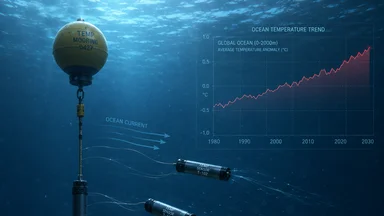
As a result, two moorings equipped with thermistors—precision temperature sensors—were left unattended. The moorings were designed to be serviced annually, with sensors calibrated against known standards. Without that maintenance, the thermistors began to drift. By the time the cable was finally repaired in 2017, the sensors were reading roughly 0.05°C warmer each year than they should have.
The drift propagated into the global sea-surface temperature record through data assimilation. Reanalysis products like ERA5 and OISST, which blend observations with model forecasts, treated the warm readings as real. Because the moorings were in a region of the North Atlantic that is sparsely sampled by other platforms, the bias was not averaged out. A 2023 paper by scientists at NOAA's Atlantic Oceanographic and Meteorological Laboratory traced the anomaly back to the missing service visits.
The effect on the global average was small—around 0.02°C—but persistent. For nearly a decade, the world's ocean temperature record was a few hundredths of a degree warmer than it should have been. That is enough to shift the significance of regional trends, especially in the North Atlantic, where the bias was concentrated.
How Ocean Temperature Records Are Actually Built
The global sea-surface temperature record is not a single measurement. It is a patchwork: Argo floats drifting with currents, satellite radiometers scanning the surface, ship intake readings from commercial vessels, and fixed moorings like the ones off Bermuda. Each data stream has its own calibration quirks, gaps, and biases.
Argo floats, for instance, measure temperature and salinity from the surface to 2,000 meters depth, but they spend most of their time underwater and only surface every ten days. Satellites see the top millimeter of the ocean, which can differ from the bulk temperature measured by floats. Ship intakes are often located near engine rooms, introducing a warm bias. Moorings provide continuous, high-frequency data at fixed points, but they require regular maintenance.
Research vessel time costs around US$ 30,000–40,000 per day. A typical mooring service cruise might take five to ten days, not counting transit. When funding runs short, mooring maintenance is often deferred. One agency estimated that roughly 30% of ocean sensors fail before their next scheduled service visit.
These infrastructure costs rarely appear in published methodology sections. A paper might state that data were collected by moorings maintained by the National Oceanic and Atmospheric Administration, but it will not mention that a cable repair was delayed for three years because of a budget gap. The assumption is that the data are continuous and unbiased. The reality is that the record is only as good as the last service visit.
The Uncosted Repair: A Worked Example
To understand how a single funding gap can ripple through a global record, it helps to follow the money. The cable ship mobilization alone exceeded €500,000. That is about the cost of a small research grant. But the telecom consortium that owned the cable did not consider mooring maintenance its responsibility, and the ocean-observing program that used the moorings did not have a half-million-euro contingency line.
The two moorings in question were part of the Ocean Observatories Initiative's Pioneer Array, a network of sensors off the U.S. East Coast. They were designed to measure the Gulf Stream and its eddies. Without annual service, the thermistors drifted. The drift was not linear—it depended on temperature and time since calibration—but it averaged roughly 0.05°C per year.
The bias entered the ERA5 reanalysis through the assimilation of mooring data. ERA5, produced by the European Centre for Medium-Range Weather Forecasts, is one of the most widely used climate datasets. It combines observations with a numerical weather model to produce a consistent, gridded record going back to 1940. The warm mooring readings were treated as truth, and the model adjusted its background field to match them.
No journal paper mentioned the funding gap that caused the drift. The NOAA 2023 study described the correction in technical terms—adjustments to thermistor calibration coefficients—but did not discuss the root cause. The uncosted repair remained invisible, except to the people who had to decide which budget to raid.
Incentives That Reward Speed Over Infrastructure
The story of the Bermuda cable is not an outlier. It is a symptom of how research incentives are structured. Grant cycles typically run three to five years, and they reward novel findings, not sustained observations. A proposal to maintain a mooring array for a decade is less likely to be funded than a proposal to test a new hypothesis about ocean circulation.
Prestige journals rarely publish papers titled “Our mooring broke and here is what happened.” The publication pressure is toward results that are clean, surprising, and publishable. Tenure committees count papers, not maintenance logs. A researcher who spends a year writing a data-quality note about a drifting thermistor has produced something that may not count toward promotion.
Long-term monitoring programs rely on soft money and goodwill. The Ocean Observatories Initiative, for example, is funded by the National Science Foundation, but its budget has not kept pace with inflation. When a cable breaks or a sensor fails, there is no reserve fund. The choice is often between deferring maintenance and canceling a research cruise.
One agency estimated that roughly 30% of ocean sensors fail before their next scheduled service visit. That estimate comes from internal reports, not published literature. The failure rate is hidden because no one wants to draw attention to it. The result is a data record that is systematically biased by the very infrastructure that produces it.
What a Properly Costed Record Would Look Like
Some researchers have proposed standards for full life-cycle budgeting. At Scripps Institution of Oceanography and NOAA's Pacific Marine Environmental Laboratory, scientists have argued that every sensor string and cable should have a contingency line for repairs. The cost increase would be roughly 10–15% of the total program budget, which is small compared to the cost of a decade of biased data.
An independent audit of data continuity before publication could catch biases like the one from the Bermuda cable. Such an audit would require access to maintenance logs, funding records, and calibration histories—information that is currently scattered across agencies and rarely shared. The NOAA 2023 study was possible only because the authors had access to the mooring's service history.
Funding agencies could require contingency lines for repairs as a condition of grant approval. The National Science Foundation's Ocean Sciences Division has discussed such requirements, but they have not been implemented. The resistance is partly cultural: scientists do not like to ask for money for things that might not happen.
A properly costed record would also include routine cross-validation between data streams. If the Bermuda moorings had been compared with nearby Argo floats or satellite data on a regular basis, the drift would have been detected earlier. But cross-validation takes time and money, and it does not produce papers. It is a form of quality control that is easy to skip.
Trade-offs and Counter-arguments
Some scientists argue that the focus on a 0.02°C bias is overblown. They point out that other sources of uncertainty—such as the choice of baseline period, the interpolation method for sparse data, and the differences between satellite and in situ measurements—are far larger. The bias from the Bermuda cable, they say, is a rounding error compared to the roughly 0.1°C disagreement between different sea-surface temperature products. In that context, spending half a million euros to prevent a 0.02°C drift may not be cost-effective.
There is also a philosophical debate about whether reanalysis products should be adjusted for every known bias. Some argue that the role of reanalyses is to provide a consistent framework, and that users should apply their own corrections. The NOAA study itself was a step toward transparency, but it also raised the question: how many other biases remain uncorrected? If every infrastructure gap were traced and corrected, the record might become a patchwork of adjustments that undermine its authority.
Another counter-argument is that the bias was detected and corrected within a decade, which is fast by the standards of climate science. The 2023 study came out roughly six years after the cable was repaired. In fields like glaciology or paleoclimatology, biases can persist for decades or centuries before they are identified. The Bermuda cable story, from this perspective, is a success story: the system worked, the error was found, and the record improved.
Still, the episode highlights a structural vulnerability. The ocean observing network is a global public good, but it is funded by a patchwork of national agencies with different priorities and budget cycles. A single cable break in a single location can introduce a bias that affects global products. The fact that it took a dedicated study to find the bias suggests that similar biases may be lurking elsewhere.
Broader Implications for Other Observing Systems
The Bermuda cable problem is not unique to oceanography. Similar issues arise in other long-term observing systems, such as the Global Positioning System (GPS) for atmospheric water vapor, seismic networks for earthquake monitoring, and the Global Atmosphere Watch for greenhouse gases. In each case, the reliability of the data depends on infrastructure that is expensive to maintain and easy to defer.
For example, the GPS network requires regular updates to satellite clocks and ground-based receivers. When budgets are tight, software updates are delayed, and the accuracy of water vapor retrievals degrades. A 2018 study found that a delay in updating receiver firmware introduced a systematic dry bias in precipitable water vapor estimates over the central United States, affecting weather forecasts and climate trend analyses.
Similarly, the Global Seismographic Network relies on a set of permanent stations that require annual maintenance. In remote locations, a failed sensor can go unreplaced for years, creating gaps in the record that complicate earthquake location and magnitude estimation. The cost of a service visit to a remote island station can exceed US$ 100,000, and there is no dedicated contingency fund.
These examples share a common pattern: the infrastructure that produces the data is treated as a fixed cost, but it is actually a variable cost that depends on continued investment. When investment lags, the data quality degrades. The degradation is often invisible to the end user, who sees only the published dataset, not the maintenance logs.
Lessons for Climate Attribution and Policy
A 0.02°C bias may sound small, but it can shift the significance of regional trends. In the North Atlantic, where the bias was concentrated, some studies of ocean heat content and Atlantic Meridional Overturning Circulation strength may have been affected. Attribution studies of extreme events—like marine heatwaves or hurricane intensification—depend on baseline accuracy.
The IPCC assessment reports rely on unadjusted global averages. The bias from the Bermuda cable was corrected before the most recent report, but the episode raises questions about how many other uncorrected biases remain. The IPCC's procedures for data quality are thorough, but they depend on the scientific community to report errors.
Policymakers treat tenths of a degree as actionable thresholds. The Paris Agreement's target of 1.5°C of warming is measured against a pre-industrial baseline. A bias of 0.02°C in the current record is small relative to the total warming, but it is not negligible. If the bias had not been corrected, it could have shifted the date at which a regional temperature threshold was crossed.
Transparent infrastructure accounting strengthens public trust. When a correction is made and explained, it shows that the system is working. But when corrections are hidden or explained only in technical supplements, the public may wonder what else has been missed. The Bermuda cable story is a reminder that the data we rely on are only as good as the infrastructure that supports them—and that infrastructure costs money, which someone has to pay.
Related: a similar tale of hidden costs in chemistry, or how grant overhead can skew results in economics. The pattern is not unique to oceanography.
The uncosted repair near Bermuda is a small example of a large problem. The ocean is vast, and the instruments that measure it are expensive and fallible. The real lesson is not that we should trust the data less, but that we should understand what it costs to produce trustworthy data—and be willing to pay it.